

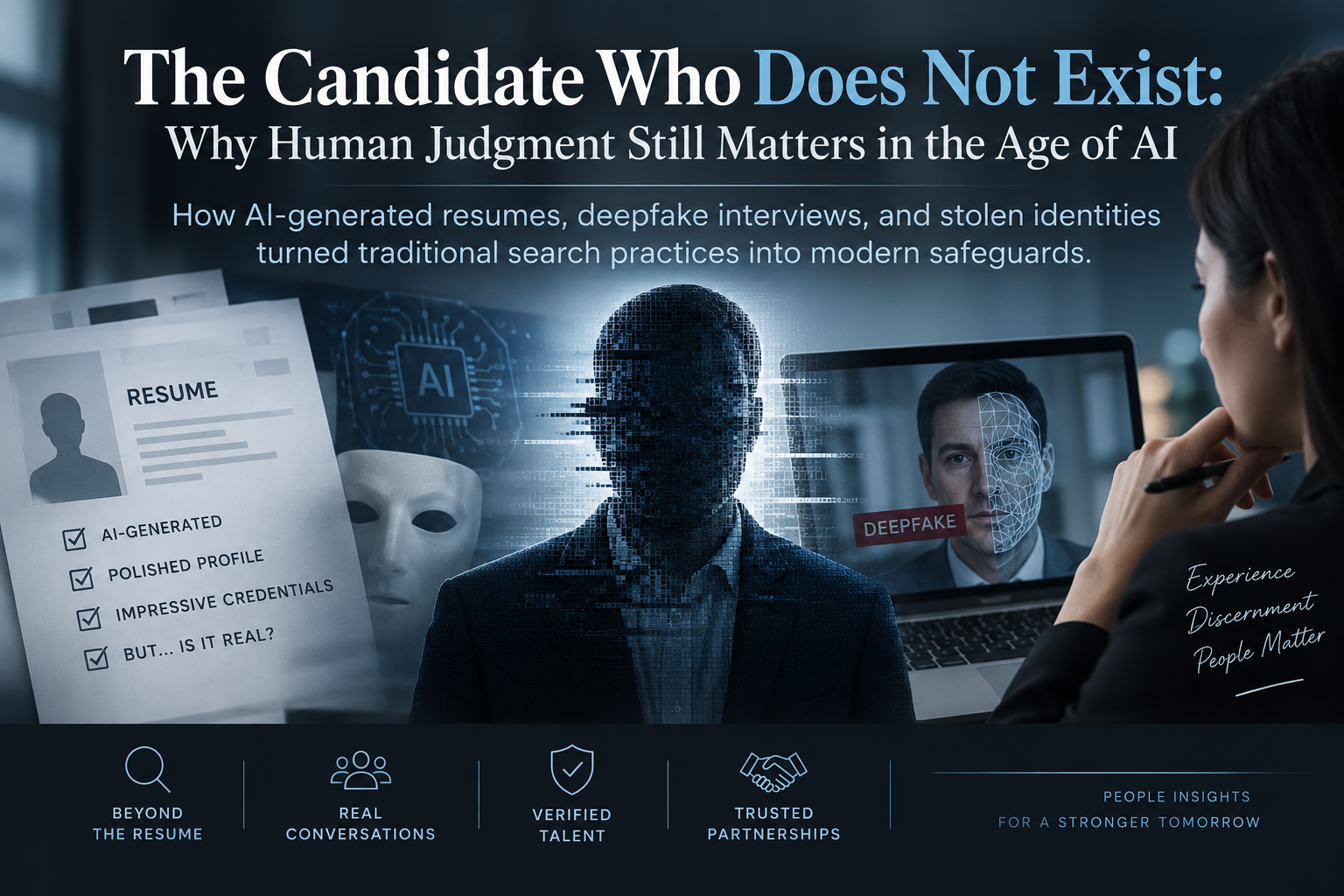
How AI-generated resumes, deepfake interviews, and stolen identities turned traditional search practices into modern safeguards.
The candidate looked ideal. Strong resume, polished answers, a confident presence on the video call. The references cleared by email. The offer went out that week.
Months later, the work did not match the interview. The person on payroll was not the person who had been hired.
That story is no longer rare, and it is worth thinking about before your next senior hire. The tools that build a convincing candidate have become cheap, fast, and widely available. A fabricated resume, a borrowed identity, coached answers, or an entirely synthetic persona now costs little to produce.
How a candidate becomes easy to manufacture
Remote hiring removed the in-person filter that used to catch problems early. A generation ago, most finalists sat across a desk. Now the first several rounds happen on camera, often across time zones, sometimes without a single face-to-face meeting.
Generative AI added a second shift. A resume tailored to a job description, complete with realistic titles, metrics, and vocabulary, now takes seconds. Cover letters, writing samples, and assessment answers follow the same pattern. A Gartner survey of 3,290 candidates, reported in its July 31, 2025 release, found that 39 percent used AI during the application process, including to write resume text and answers to assessment questions.
None of this means most candidates act in bad faith. The point is narrower. The cost of looking qualified has dropped, and the cost of looking like someone else has dropped with it.
What the research shows
Two findings deserve attention, with their context intact.
Gartner projects that by 2028, one in four candidate profiles worldwide will be fake. That figure, published on July 31, 2025, refers to candidate profiles, not confirmed hires. It spans a wide range, from an AI-polished resume that inflates a real person to full impersonation with a stolen identity. In the same research, 6 percent of candidates admitted to interview fraud, meaning they posed as someone else or had someone else pose for them.
The second finding is more specific. In cases unsealed in May 2024, the U.S. Department of Justice described a scheme in which North Korean information-technology workers used stolen or borrowed identities to obtain remote jobs at more than 300 U.S. companies. The workers posed as U.S. residents, and the identities of more than 60 Americans were compromised. Some of the affected employers were Fortune 500 companies and financial firms. This case centered on remote IT roles and on revenue that funded a sanctioned regime. It is not a claim about every role or every remote worker. It is a clear example of what a coordinated identity scheme looks like when it succeeds.
Read together, the two findings frame the problem well. Fraud runs on a spectrum, from a candidate who oversells to an operation built to deceive.
The business risks
The reason this matters to a CEO or a board is not the resume itself. It is what the hire touches. A leader or specialist hired under a false identity often receives:
- Access to company systems and confidential information
- A place in payroll and financial workflows
- Exposure to intellectual property and product plans
- A role in regulated or contractual obligations
When any of these go wrong, the damage reaches past the one bad hire. It reaches clients who trusted the placement, employees who onboarded a stranger, and investors who backed the plan. A failed executive hire is expensive on its own. A fraudulent one adds legal, financial, and reputational exposure on top.
Why automated screening alone falls short
Many teams have added AI tools to sort applications and flag anomalies. Those tools help with volume. They do not settle the harder question of whether the person is who they claim to be.
The reason is simple. The same technology that helps a company screen also helps a dishonest applicant perform. A model that writes a strong answer for a recruiter writes an equally strong answer for a fraud. An automated video screen that reads confidence reads coached confidence the same way. Speed on both sides tends to cancel out.
Screening narrows a field. It does not confirm a story. Confirmation still takes a person who knows what a real career in that field looks like.
Where relationships become a control
This is where a retained search built on relationships earns its keep.
At DSI, we often know the companies and the executives in our markets by name. We understand the realistic career paths, the reporting lines, and the moves that make sense in an industry. When a candidate’s history does not fit those patterns, an experienced recruiter notices. An automated system rarely does.
Depth helps too. A single interview is easy to script. A series of live conversations, detailed questions about specific projects, and follow-ups on timelines and results are much harder to fake across weeks. A fabricated story tends to crack under repetition.
References close part of the gap. When we reach people through channels we confirm ourselves, rather than the contacts a candidate hands us, we hear whether the professional reputation is real.
None of this eliminates fraud. It is one strong layer in a larger system that also includes independent identity, employment, and background checks. Personal knowledge finds the inconsistencies earlier, so the rest of the system has less to catch.
How DSI evaluates and verifies
Our process is structured, and each step adds a look from a different angle.
- Personal outreach. We recruit candidates directly rather than wait for inbound applications, so the conversation starts with a known person in a known market.
- Live and video interviews. We speak with candidates directly, more than once, and note how the story holds up.
- Detailed career questioning. We ask about specific projects, reporting relationships, results, and timelines, then compare the answers to the resume.
- Written questionnaires. Each candidate completes a questionnaire that puts the same history in writing.
- Behavioral and cognitive assessments. Where a search calls for it, we use assessments to understand how a candidate works. We treat these as evaluation tools, not proof of identity.
- Written candidate scorecards. We measure each candidate against the client’s defined requirements.
- Detailed write-ups. We produce a first-person write-up for each finalist that lays out the summary, the fit to the job description, and any watch-outs.
- Professional reference checks. We gather references through verified channels and record what we hear.
Read across those steps, the resume, the LinkedIn profile, the questionnaire, the assessment, the interviews, and the references should tell one consistent story. When they do not, that gap is the signal.
One caution. Our work evaluates a candidate’s experience, fit, and credibility. It is not the same as formal identity verification, employment verification, or a background check performed by a licensed provider. Those steps belong in the process too. We help clients see risk earlier, so those checks are aimed well.
An executive checklist
For leaders hiring into sensitive or high-impact roles, a short discipline goes a long way:
- Confirm identity at appropriate stages of the process.
- Verify employment and education independently, through the institutions themselves.
- Hold live video and substantive interviews, not a single screen.
- Ask detailed questions about projects, reporting relationships, results, and timelines.
- Contact references through channels you verify yourself, not only the ones provided.
- Compare information across the resume, LinkedIn profile, questionnaires, assessments, interviews, and references.
- Add cybersecurity and identity controls for remote employees who will access sensitive systems.
- Follow applicable employment and privacy laws at every step.
The May 16, 2022 advisory from the FBI, the U.S. Department of State, and the U.S. Department of the Treasury recommends similar measures for remote roles, including verifying documents directly with the listed employers and schools and holding a video interview to confirm identity.
Why knowing the market matters
A checklist works better in trained hands. A recruiter who has spent years inside an industry carries a map that no form contains. That recruiter knows which companies are real competitors, which titles carry which scope, and which career moves are plausible. Against that map, a manufactured history stands out.
DSI has built that kind of knowledge in Utah and across the direct-selling and consumer industries over more than 25 years. When we read a candidate’s path, we compare it to hundreds of real ones we already know. Context is the difference between a story that sounds right and a story that is right.
What has changed
For years, personal outreach, live conversations, detailed questioning, reference checks, and relationship-based recruiting looked old-fashioned. Some viewed them as slow. The market has changed the math. Those same practices now catch problems that fast, automated hiring misses.
What once looked traditional now functions as a modern risk control.
——————————————————————————————————–
Scott Driggs is President and CEO of Driggs Search International, a retained executive search firm based in South Jordan, Utah. www.driggssearch.com
Sources and further reading
- Gartner, “Gartner Survey Shows Just 26% of Job Applicants Trust AI Will Fairly Evaluate Them,” July 31, 2025. https://www.gartner.com/en/newsroom/press-releases/2025-07-31-gartner-survey-shows-just-26-percent-of-job-applicants-trust-ai-will-fairly-evaluate-them
- U.S. Department of Justice, U.S. Attorney’s Office for the District of Columbia, announcement on the remote North Korean IT worker fraud scheme affecting more than 300 U.S. companies (case unsealed May 2024). https://www.justice.gov/usao-dc/pr/charges-and-seizures-brought-fraud-scheme-aimed-denying-revenue-workers-associated-north
- U.S. Department of Justice, “Two North Korean Nationals and Three Facilitators Indicted for Multi-Year Fraudulent Remote Information Technology Worker Scheme,” January 23, 2025. https://www.justice.gov/opa/pr/two-north-korean-nationals-and-three-facilitators-indicted-multi-year-fraudulent-remote
- FBI, U.S. Department of State, and U.S. Department of the Treasury, “Guidance on the Democratic People’s Republic of Korea Information Technology Workers” (tri-seal advisory), May 16, 2022. https://ofac.treasury.gov/media/923126/download?inline=
- FBI Internet Crime Complaint Center (IC3), “Deepfakes and Stolen PII Utilized to Apply for Remote Work Positions,” June 28, 2022. https://www.ic3.gov/PSA/2022/psa220628